Something Deeply Wrong With Keir Starmer
Keir Starmer: Britain’s First Algorithmic Prime Minister

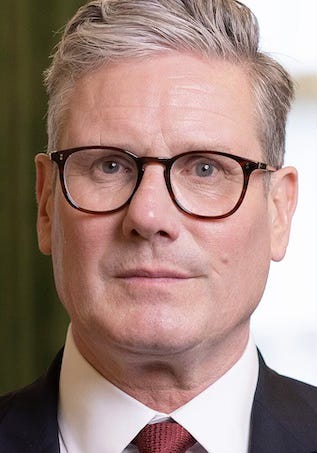
There are many ways a politician can fail. They can be corrupt. They can be stupid. They can be lazy. Or — in rare and particularly hazardous cases — they can be spectacularly wrong about everything while remaining serenely convinced of their own brilliance.
Keir Starmer has perfected this final, most irritating form of failure.
He does not blunder into bad decisions like a drunk tourist wandering into traffic. No. He advances toward them with the calm, upright posture of a man who believes history will thank him for his paperwork. Every mistake is delivered with total confidence, as though error itself has been peer-reviewed.
Watching him govern is like watching someone reverse a car into a wall, get out, check the Highway Code, nod approvingly, and then reverse into it again — harder — because the manual didn’t explicitly say not to.
The problem, you see, is not that Starmer lacks intelligence. It’s that he lacks judgment. Intelligence without judgment is what gives you nuclear power plants run by accountants. Or, in this case, a country run by a former lawyer who appears to believe morality is a sub-clause.
Starmer’s moral compass does not point north. It points to “approved framework.” Right and wrong are not instincts to him; they are downloadable PDFs. When faced with a difficult human problem, he does not ask, “What is the right thing to do?” He asks, “What is the most defensible thing to say?”
This is why he speaks endlessly yet communicates nothing. He doesn’t respond — he outputs. His speeches have the warmth of an automated voicemail and the empathy of a parking fine.
People often say he “lacks charisma,” which is like saying the Titanic “lacked buoyancy.” Charisma is not the issue. The issue is that he appears fundamentally disconnected from the emotional operating system of the species he is supposed to lead.
He cannot read a room because he does not believe rooms matter. Crowds, anger, grief, outrage — these are just inconvenient data spikes. Noise. Something to be smoothed over with “appropriate language” and “clear processes going forward.”
And when reality clashes with process, reality must obviously apologise.
This was laid bare in the aftermath of the Southport tragedy. Britain was shocked. People were grieving. The country was raw, angry, frightened, and demanding something — anything — resembling human leadership.
What they got instead was a statement that sounded like it had been written by a mid-level HR manager who’d been told to “keep it neutral” and “avoid emotional liability.” No warmth. No instinct. No recognition that people were hurting. Just clean, sterile, ideologically disinfected phrasing.
It wasn’t malicious. That’s the worst part. It was vacant.
Like watching a robot attempt sympathy after being briefly shown a YouTube tutorial called Human Emotion: A Beginner’s Guide.
Starmer’s defenders insist this is “seriousness.” It isn’t. Serious people understand when rules stop working. Serious leaders know when law bows to morality, not the other way around. Starmer, by contrast, appears to believe that if something is technically compliant, it must also be correct — and if people disagree, they are simply experiencing feelings incorrectly.
This is governance as spreadsheet management.
And it produces a particularly British nightmare: a man with enormous power who is incapable of understanding why the public keeps reacting badly to his decisions, because from his perspective, everything has been done “properly.”
If Britain were on fire, Starmer would form a working group. He would commission a review. He would announce a phased response plan. He would assure us the flames were being taken “extremely seriously.” And then he would quietly explain why pouring water directly on the fire was “not appropriate at this stage.”
There is no passion here. No fire. No danger. Just a relentless, grinding mediocrity wrapped in legal certainty.
He is not a tyrant. Tyrants believe in something. He is not a villain. Villains have intent. Starmer is something far more insidious: a man who believes leadership is merely the correct application of rules, regardless of outcome.
Britain does not need another manager. It needs judgment. It needs instinct. It needs someone capable of recognising when the country is not asking for process, but for leadership.
Instead, we have a man who governs like a software update: nobody asked for it, it breaks several vital functions, and when people complain, they’re told it’s actually an improvement.
Keir Starmer is not steering Britain toward disaster out of malice. He’s doing it out of confidence. Absolute, unshakeable confidence — in the wrong answer.
And that, frankly, is the most British tragedy of all.
Easy. He’s personality disordered.
Former SPAD to him, talking on the radio a few months back…
“He’s a hollow man, who cannot stop lying…”
Sociopath. Here’s the symptoms I see …recognised by a very nasty incident with a bloke I had know for 30+ years, since we’d been at college in the early 70s. I challenged him about his abuse of a lovely woman I also know.
BANG! Bonus? I can spot them a mile off now…
No empathy. Witness him ignoring Reeves in tears at his side. A human being would have consoled her.
No sense of humour.
No emotions.
No inner life (doesn't read, do art - openly admitted so).
Bristles when challenged.
Hates being laughed at (viz. TV audience at his “Son of a toolmaker” spiel) – which he has not repeated since having been unable to stop saying it previously..
Pathological liar. As confirmed by a former SPAD (Starmer is "a hollow man").
Refuses to take responsibility for things that happened on his watch..
No soul. Look into his eyes. Nothing there. The eyes are where we see another.
Lovely article which points to an underlying sense of unease that many people have about Starmer. He seems pre-programmed to do certain things without having the slightest capacity to check performance against reality.
That might be due to a very thick skin and a determination to press on with his programme without publicly registering his acknowledgement of others’ distress. “Just do it, Keir! Ignore the nay-sayers and act like you don’t care!”
The alternative is that he is one very sick little puppy.